Friday, November 11, 2022

Music for November 13, 2022 + The Twenty-third Sunday after Pentecost

Vocal Music

  • Like a Tree – Ruth Elaine Schram (b. 1956)
  • He That Shall Endure to the End – Felix Mendelssohn (1809 - 1847 )

Instrumental Music

  • Highland Cathedral – Ulrich Roever and Michael Korb, arr James Wetherald
  • Elegy – John Carter (b. 1930)
  • Traditional Bagpipe tunes – Stanley Fontenot, piper 

Congregational Music (all hymns from The Hymnal 1982 with the exception of those marked “R” which are from Renew.)

  • Hymn R122 Canticle 9: Surely it is God who saves me (THE FIRST SONG OF ISAIAH)
  • Hymn From North and South (LASST UNS ERFREUEN)
  • Hymn R168 If you believe and I believe (IF YOU BELIEVE)
  • Hymn 671 Amazing Grace, how sweet the sound (NEW BRITAIN)

Like a Tree

Today marks the first time our children's choir has sung in church in over two years. I am delighted that the Coventry Choir will be singing this anthem inspired by Psalm 1 

Ruth Elaine Schram
1 Blessed is the one who does not walk in step with the wicked or stand in the way that sinners take
    or sit in the company of mockers,
2 but whose delight is in the law of the Lord,
    and who meditates on his law day and night.
3 That person is like a tree planted by streams of water,
    which yields its fruit in season and whose leaf does not wither - 

This song is by Ruth Elaine Schram, an American composer who specializes in choral music for church and school choirs. She wrote her first song at the age of twelve, and her first song was published twenty years later, in 1988. In 1992, she became a full‑time composer and arranger and now has over 2,000 published works. Over thirteen million copies of Schram's songs have been purchased in their various venues, and she has been a recipient of the ASCAP Special Award each year since 1990. In addition to Schram's choral music, her songs appear on thirty albums (four of which have been Dove Award finalists) and numerous children's videos. Schram's songs have also appeared on such diverse television shows as The 700 Club and HBO's acclaimed series The Sopranos.

Schram began piano and theory lessons at the age of five. She studied music at Lancaster Bible College and Millersville State College and taught Elementary Music in Pennsylvania for several years. Schram now lives in Birmingham, Alabama with her husband, Scott, and they have two grown daughters, Crystie and Celsie.

He That Shall Endure to the End


Felix Mendelssohn
painting by Eduard Magnus, ca 1845
This work from Mendelssohn's oratorio, Elijah, comes in the second half of the oratorio, which tells the life of the prophet Elijah which epitomized the evolution of Jewish faith from worship of the Babylonian pantheon of idols and myths to worshipping one monotheistic God. 

In the second half, we hear that God comforts those who follow his commandments. In ridding the land of Baal worship, Elijah has challenged King Ahab, ruler of Israel. His wife, Queen Jezebel, incites the crowd against Elijah. Disheartened, Elijah sings “It is enough.” 

Elijah awaits God on Mount Horeb, longing for death. Angels once again arrive to restore his spirit with the words, “Lift thine eyes to the mountains.” Elijah’s hope resurfaces, and the chorus sings this chorale, with words from Jesus found in the Gospel of Matthew.

We are singing this today in response to the Gospel reading which ends, "By your endurance you will gain your souls."

Elegy


John Carter
Elegy was composed for piano solo in memory and in grief for the students and teachers of the Robb Elementary School, Uvalde, Texas. It features a quiet, somber rhythm pattern with twenty-one bell-like tones, one for each person who perished on that awful day. It is quiet, somber, and dramatic.

Carter is Director of Music at University Baptist Church, Columbus, OH. He was born in Nashville, TN and received his B.M. from Trinity University in San Antonio and an M.M. from Peabody College in Nashville. John is a prolific composer with several hundred choral compositions to his credit as well as several musicals, an opera, and a dozen collections for keyboard and organ. He and his wife, Mary Kay Beall, often collaborate in composition.


Saturday, November 5, 2022

SWINGING SAINTS! Music for November 6, 2022 + All Saints (Observed)

Vocal Music

  • By All Your Saints – Joel Martinson, arr. (b. 1960)

Instrumental Music

  • Morning Canticle – Sondra Tucker (b. 1957)
  • How Can I Keep from Singing – Sondra Tucker, arr.
  • Sine Nomine – John Weaver (1937-2021)

Congregational Music (all hymns from The Hymnal 1982 with the exception of those marked “R” which are from Renew.)

  • Hymn 287 For all the saints, who from their labors rest (SINE NOMINE)
  • Hymn 286 Who are these like stars appearing? (ZEUCH MICH, ZEUCH MICH)
  • Hymn 618 Ye watchers and ye holy ones (LAAST UNS ERFREUEN)
  • Hymn R127 Blessed are they, the poor in spirit (BLEST ARE THEY)
  • Hymn 625 Ye holy angels bright (DARWALL’S 148TH)
It's not your usual Sunday  (musically) at Good Shepherd. First, its the Sunday we observe All Saints Day (which is on November 1st).  We remember those who have died and have "gone before," as they say. We usually use music by the "saints" of church music, (read "dead, white men") but today we also offer choral and instrumental music by a living white man AND a woman. We can feel the earth shake even as we write this. Read on.

By All Your Saints


For the offering, the choir will sing an setting of hymn 231, a poem by Horatio Nelson (a British politician and relative of the famous Naval hero Lord Nelson) set to a Finnish folk tune, NYLAND. It is arranged by Joel Martinson, director of Music Ministries and Organist at The Episcopal Church of the Transfiguration in Dallas, Texas.


Morning Canticle and How Can I Keep From Singing    


These two handbell pieces, played by our Good Shepherd Bell Choir, are by the Houston composer Sondra Tucker. Sondra and I have known each other since our days together in Memphis, over 25 years ago. She has served Presbyterian and Episcopal Congregations in both Memphis and Houston, and is currently the director of the Houston Bronze Ensemble, a professional handbell group in Houston (of which I am a member.) She is also acting as organist and choir director at First Congregational Church of Houston.

The prelude, Morning Canticle, is a bright, original tune which sparks an interesting match with the melody of "Holy Holy Holy", which is played by handchimes in the middle of the piece.

The communion piece is a lovely arrangement of the American Gospel hymn, How Can I Keep From Singing. The text and tune were both written by Robert Lowry, a Baptist minister who became a popular writer of gospel music in the mid- to late-19th century. His best-known hymns include "Shall We Gather at the River", "Christ Arose!", and "Nothing But The Blood Of Jesus". Despite his protestations that preaching was his main vocation and that music was merely a sideline, it is as a hymnwriter that Lowry is chiefly remembered. 

I think it's funny that I first heard this hymn not in church but on a CD of music by the New-Age singer/musician Enya, who changed some more overtly Christian lines.

In this arrangement we will also hear the handchimes playing the melody on the middle verse of the hymn.

Sine Nomine


Of all the music we are presenting this Sunday, the one I am most excited about is the closing voluntary, Sine Nomine. "SINE NOMINE is the tune name of the opening hymn this morning, the wonderful All Saints hymn, For all the saints, who from their labors rest. But did you know that SINE NOMINE is not the first, much less the only tune for that hymn? When the hymn was first published, it was sung to the melody SARUM, by the Victorian composer Joseph Barnby, until the publication of the English Hymnal in 1906 when Ralph Vaughan Williams, the editor of that hymnal, wrote a new tune which he called SINE NOMINE.  The tune's title means "without name" and follows the Renaissance tradition of naming certain compositions "Sine Nomine" if they were not settings for preexisting tunes.

What excited me about this organ piece is that it combines both the original tune SARUM with the later tune SINE NOMINE. But wait! THERE'S MORE! It also combines the Black spiritual, When the Saints Go Marching In with SINE NOMINE. And, if that is not enough, the whole piece is played in a Dixieland Jazz style! Yes, folks, you read that right. The hymn tune many consider to be the epitome of Anglican hymn tunes is given the Dixieland treatment. 

This genius "mash-up" was the brain child of American organist John Weaver. Weaver served as Organist and Director of Music at the Madison Avenue Presbyterian Church from 1970-2005. He also headed the Organ Department of the Curtis Institute of Music in Philadelphia from 1972-2003 AND chaired the Juilliard School's Organ Department from 1987-2004.

Originally, this was the closing movement of a Hymn Sonata, commissioned by the Reuter Organ Company for the dedication recital at Shadyside Presbyterian Church in 1995. The style of a New Orleans Dixieland band infuses the entire piece, and Sine Nomine sounds unexpectedly right with dotted rhythms and jazz harmonies! The juxtaposition with Oh, When the Saints also draws attention to the fact that the opening of one tune is the inversion of the other.

A lyrical statement of SARUM, with its repeated notes and foursquare feel, essentially acts as a contrasting second subject. Following this there is another statement of SINE NOMINE as a jazz trumpet solo, after which SARUM and SINE NOMINE are combined. Finally, SINE NOMINE and Oh, When the Saints Go Marching In are grandly combined.

Saturday, October 29, 2022

THE PERSONAL CONNECTION - Music for October 30, 2022 + The Twenty-First Sunday after Pentecost

Vocal Music

  • I Sought the Lord – David Ashley White
  • Good Shepherd, You Know Us – David Ashley White

Instrumental Music

  • Suite Gothic Op. 25 – Léon Boëllmann (1862-1897)
  1. Introduction – Chorale
  2. Menuet Gothique
  3. Prière à Notre Dame – Léon Boëllmann
  4. Toccata – Léon Boëllmann

Congregational Music (all hymns from The Hymnal 1982 with the exception of those marked “R” which are from Renew.)

  • Hymn 688  - A mighty fortress is our God (EIN FESTE BURG)
  • Hymn - Blessed assurance (ASSURANCE)
  • Hymn 301 - Bread of the world, in mercy broken (RENDEZ A DIEU)
  • Hymn 607 - O God of every nation (LLANGLOFFAN)
  • Psalm 119:137-144 – Tone VIIIa
Today we sing two pieces by the Houston composer David Ashley White with direct connections to Good Shepherd.

I Sought the Lord

25 years ago, when I first came to Good Shepherd, we had a young mother singing in our choir with a toddler. As the dad wasn't a church goer, she would bring the young boy with her to church on Sunday, and he would sit in the loft with us. People in the congregation down below began to look for his round, cherubic face pressed up against the glass which use to be in the choir loft rail. But life happened, and a divorce brought about a move from the suburb of Kingwood to the inner loop of Houston, and thus a move from Good Shepherd to Palmer Memorial. We missed young Thomas' growing up, and his subsequent battle with cancer, but we kept up through our friendship with his mother, Sarah and social media. Thomas won his battle with cancer, but lost his war with depression. He passed away in August of 2017.

Our mutual friend and church musician/composer, David Ashley White, wrote a beautiful anthem which he dedicated to Sarah Emes and her son, Thomas Oldrin. With a text by an anonymous poet, the anthem was premiered by the Palmer choir and published by Selah Publishing Co. in June 2018. Sarah gave copies of the anthem to Good Shepherd so that we, too, could sing in memory of Thomas.

Good Shepherd, You Know Us


When the congregation and choirs of Good Shepherd celebrated my 25th Anniversary at Good Shepherd on September 11, the celebration included a new hymn written for the occasion by David, which was sung by the choir. We've been practicing it to learn the harmonies, and will sing it again this Sunday during communion. 

Most people don’t realize that a hymn has two parts. One is the text. When Pam Nolting asked David about composing something, he immediately suggested a hymn text by one of his favorite writers, Christopher Idle, a priest in the Anglican Church. The text is perfect for our congregation:
Good Shepherd, you know us, you call us by name,
you lead us; we gladly acknowledge your claim.
Your voice has compelled us; we come at your call,
and none you have chosen will finally fall.

Good Shepherd, you warn us of robbers and thieves;
the hireling, the wolf, who destroys and deceives;
all praise for your promise on which we can stand,
that no-one can snatch us from out of your hand.

Good Shepherd, you lay down your life for the sheep;
your love is not fickle, your gift is not cheap.
You spend your life freely, you take it again;
you died, so we live - we are healed by your pain.

At one with the Father, you made yourself known:
'I am the Good Shepherd', at one with your own.
You loved us before we had heeded or heard;
by grace we respond to your life-giving word.
Christopher Idle b.1938, © Christopher Idle/ Jubilate Hymns

The second part of a hymn is the tune, and the tune has its own title. The tune name for this is, appropriately, Good Shepherd, Kingwood. 

Suite Gothique


In a non-liutrgical nod to All Hallows Eve, I am playing the complete Gothic Suite by French composer Léon Boëllmann. Boëllmann was born on September 25, 1862 in Ensisheim on the Upper Rhine. At the age of 9 he left his homeland and entered Louis Niedermeyer's École de Musique classique et religieuse in Paris. Among his teachers and patrons were the well-known organists Gustave Lefèvre and especially Eugène Gigout, who later even adopted him. In 1881 he graduated from the École with a diploma as an organist and another as a cantor, and became an organist at the Church of St. Vincent-de-Paul in Paris. He later got the position of first organist there. After the founding of the École d'orgue et d'improvisation by Gigout, Boëllmann worked simultaneously as an organist at St. Vincent-de-Paul, as a teacher at his adoptive father's school and as a composer. He also worked as a music critic. Léon Boëllmann died on October 11, 1897 at the age of 35.

His best-known work today is the Suite Gothique op. 25, especially the last movement, the Toccata. This four-movement suite opens with the Introduction in C minor, a chorale rendered in an archaic, neo-modal style. This is followed by the Menuet Gothique, a curious mixture of ecclesiatical-liturgical austerity and eighteenth-century elegance: It begins with a C major minuet, which in the running movement takes on increasingly modal traits through the use of flat sevenths in the harmonies. The contrasting middle section develops through a variety of new keys with a merrily ascending motif of broken chords, producing some brief reminiscences of the opening minute before a recapitulation of the first section rounds out the movement. 

The third movement, Prière à Notre Dame , is in A flat major. A recurring sinuous melody in the muted registers exudes a devotional atmosphere. This is answered by three passages based on a romantic progression of harmony in the unrelated keys of D flat major and E major.

The following Toccata in C minor is not without reason the most played movement from this suite. Brilliant manual figurations over a broad pedal theme create great effect. The somewhat macabre pedal theme rises in dotted rhythm to the flattened dominant, turning the harmonies to D flat major for a few bars. In contrast, a rhythmic, syncopated melody rises in the manual, accompanied by the semitone motif that can be heard at the beginning of the movement. Finally, after some repetitions of these elements in different keys, increasing in dynamism and intensity, the coda brings back the opening theme, played in pedal octaves in triple forte – the dynamic and effective climax to close the suite.

Thursday, October 20, 2022

A NEW SONG: Music for October 23, 2022 + The Twentieth Sunday after Pentecost

Vocal Music

  • Oh, Sing to the Lord a New Song – John Leavitt (b. 1956)

Instrumental Music

  • Chorale Prelude on a Melody by Orlando Gibbons – Healey Willan (1880-1968)
  • Sonata IV: Andante – Johann Sebastian Bach (1685-1750)
  • Finale in D Minor – Eric H. Thiman (1900-1975)

Congregational Music (all hymns from The Hymnal 1982.)

  • Hymn 680 O God, our help in ages past (ST. ANNE)
  • Hymn 686 Come, thou fount of every blessing (NETTLETON)
  • Hymn 424 For the fruit of all creation (EAST ACKLAM)
  • Hymn 693 Just as I am (WOODWORTH)
  • Hymn 636 How firm a foundation (FOUNDATION)
  • Psalm 84:1-6 – Tone VIIIa

Oh, Sing to the Lord a New Song

This anthem is a departure from our usually sedate, organ-based fare. It is a contemporary setting of a contemporary paraphrase of Psalm 96. The composer of the piece is John Leavitt, a Kansas native who devotes himself full-time to composing and conducting. He is the artistic director and conductor of a professionally trained vocal ensemble known as The Master Arts Chorale and an associated children's choir, The Master Arts Youth Chorale, both in Wichita.

Born and raised in Leavenworth, Kansas, Leavitt did his undergraduate work is in Music Education at Emporia State University. After graduation, Leavitt moved to Wichita, Kansas where he worked in television for five years. At Wichita State University he pursued a Master of Music degree in Piano Performance with significant study in composition. While in Wichita he directed the parish music program at Immanuel Lutheran Church and served on the faculty at Friends University where he won the faculty award for teaching excellence in 1989.

He completed doctoral work in Choral Conducting at the University of Missouri-Kansas City Conservatory of Music. 

Chorale Prelude on a Melody by Orland Gibbons


The melody by Orlando Gibbons, an English composer who lived in last half of the 16th century and the first quarter of the 17th century, can be found in our hymnal at hymn 670. In addition to his instrumental and choral works, Gibbons also wrote many hymn tunes, 17 of which were included in George Withers' 'Hymnes and Songs of the Church', published in 1623.

It is arranged by Healey Willan, the Canadian organist, who spent most of his professional career at St. Mary the Virgin in Toronto. Though born in England, Willan moved to Canada in in13, when he was 33, and spent the rest of his life there, becoming known as "the Dean of Canadian composers." 

He composed more than 800 works including operas, symphonies, chamber music, a concerto, and pieces for band, orchestra, organ, and piano, but his best known works are his church music.

Sonata in E Minor: II. Andante


The communion voluntary is the second movement of a Trio Sonata by J. S. Bach. Bach compiled six “sonatas” for organ, reworking and expanding upon various earlier pieces. The fourth of these is designated as a “Trio sonata” in E minor, BWV 528, which simply describes three-part music written for two manuals and pedal.

The middle Andante movement in B minor features imitative interplay between the two voices in the manuals, while the pedal provides the bass line.

Finale in D Minor


The closing voluntary is by one of the leading organ composers from England of the 20th century. Eric Thiman was born in 1900 in Ashford, Kent, and spent his life in or around London.

Though largely self-taught, he became a Fellow of the Royal College of Organists at twenty-one, and a Doctor of Music of London University at twenty-seven – at the time the youngest person ever to achieve that qualification.

From 1931 he was Professor of Harmony at the Royal Academy of Music and was appointed Dean of the Music Faculty at London University in 1956. He was warmly respected and a gifted and patient teacher.

Unlike many of the well known organists in Great Britain, Thiman was not an Anglican. He was organist and Choir Director at two big non-conformist churches, Park Chapel, Hornsey (England) and City Temple in London. 

Thursday, October 13, 2022

THESE ARE DIFFICULT TIMES - Music for Sunday, October 16, 2022 + Day School Sunday

Vocal Music

  • Jesus, Jesus – Sunday School Song
  • Shalom – Hebrew Melody

Instrumental Music

  • Prelude on “Liebster Jesu” – Timothy Albrecht (b. 1950)
  • Autumn – Antonio Vivaldi (1678-1741)
  • Serenade for Organ, Opus 22 – Derek Bourgeois (1941-2017)

Congregational Music (all hymns from The Hymnal 1982 with the exception of those marked “R” which are from Renew.)

Hymn 372 - Praise to the living God! (LEONI)
Hymn 631 - Book of books, our people’s strength (LIEBSTER JESU)
Hymn 535 - Ye servants of God, your Master proclaim (PADERBORN)
Hymn 711 - Seek ye first the kingdom of God (SEEK YE FIRST)
Hymn 530 - Spread, O spread, thou mighty word (GOTT SEI DANK)

This Sunday we will hear from the children of Good Shepherd School, lead by their music teacher Karen Silva. You will be amazed at what children ages 3-5 can do when it comes to vocal and instrumental music. We  are very fortunate to have the school here at our church, and they are lucky to have Karen teaching them about pitch, rhythm, and instruments.

Autumn from The Four Seasons    

One of the most amazing things they'll be doing is an instrumental number arranged from the first movement of Vivaldi's AUTUMN from "The Four Seasons." Intead of strings (like the original), the children will be using chimes and Boomwhackers®, color-coded, plastic, pitched, percussion tubes, designed to be 'whacked' against any surface, for a focused sound. Imagine playing music on empty rolls of wrapping paper. 

Prelude on Liebster Jesu and Serenade

There is a meme floating around musical circles that says
THESE ARE DIFFICULT TIMES

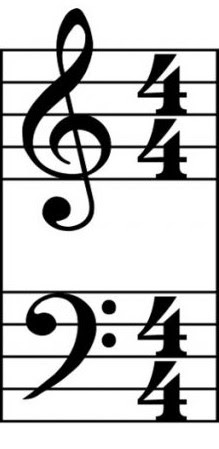
Most beginner musicians start with the simple meter of common time, or four beats per measure.
For some reason (fate? masochism?) I have chosen not just one but TWO organ voluntaries written in something one could call 'difficult times.'  Take a look at the time signature for the opening voluntary, a prelude based on hymn 631:
That means 10 beats per measure, with the 8th note getting the beat. Here is how the composer, Timothy Albrecth, organist emeritus of Emory Universoty, explains it:
SO I need to feel it in a group of 1, a group of 2, a group of three, then a group of four. This makes for a fun time, let me tell you!

But that is nothing in comparison with the closing voluntary, a piece called Serenade. Look at this time signature:
It starts out as 3+3+2+3, but later on he changes it to 13 beats to a measure. The composer wrote this for his own wedding in 1965 to be played by the organist as the guests left the ceremony. Not wishing to allow them the luxury of proceeding in an orderly 2/4, the composer wrote the work in 11/8, and in case anyone felt too comfortable, he changed it to 13/8 in the middle! The work has now been released in a number of different orchestrations of the original version for organ. This delightful miniature has entered the repertoire throughout the world.


Wednesday, October 5, 2022

Music for Sunday, October 9, 2022 + The Eighteenth Sunday after Pentecost

Vocal Music

  • Thee We Adore – T. F. H. Candlyn (1892-1964)

Instrumental Music

  • Andante in D Major – Felix Mendelssohn (1809-1847)
  • The Infinite Meadows of Heaven – Paul Mealor (b. 1975)
  • Praise to the Lord, the Almighty – Max Reger (1873-1916)

Congregational Music (all hymns from The Hymnal 1982 with the exception of those marked “R” which are from Renew.)

  • Hymn 411 O bless the Lord, my soul (ST. THOMAS (WILLIAMS))
  • Hymn 644 How sweet the name of Jesus sounds (ST. PETER)
  • Hymn 295 Sing praise to our creator (CHRISTUS, DER IST MEIN LEBEN)
  • Hymn 390 Praise to the Lord, the Almighty (LOBE DEN HERREN)
  • Hymn R 266 Give thanks with a grateful heart (GIVE THANKS)
  • Hymn 397 Now thank we all our God (NUN DANLET ALLE GOTT)
  • Psalm 111 – Tone VIIIa

Thee We Adore

This is an anthem based on a hymn by St. Thomas Aquinas. The tune is in our hymnal, using a different translation of the original Latin text (hymn 314). 

The arrangement is by Thomas Frederick Handel Candlyn, English-born organist, composer and choirmaster who spent most of his professional career at two Episcopal Church congregations in New York. After graduating from Durham University in 1911 with  the Bachelor of Music degree, he was offered the position of organist and choirmaster at St. Paul's Church, Albany, New York by its rector Dr. Roelif H. Brooks and he emigrated to the United States. He was to remain at St. Paul’s for twenty-eight years, with the exception of the period between September 21, 1917 and April 25, 1919 when he served with the American Expeditionary Forces (AEF) during World War I.

In 1943, Dr. Brooks (who had left Albany in 1926) offered Candlyn the position of organist and choirmaster at St. Thomas Episcopal Church, New York. where he worked until his retirement in 1954.

Although he composed two hundred works, primarily anthems, cantatas, service settings and organ solos, only three of his anthems ("Christ, whose glory fills the skies," "Thee We Adore," and "King of Glory, King of Peace") remain part of the standard repertoire of Episcopal church choirs in North America.

Andante in D Major

Although Mendelssohn was most famous during his lifetime as a composer, virtuoso pianist, and conductor, he also enjoyed an enviable reputation as a highly skilled organist. The instrument had fascinated — one might almost say mesmerized — him from earliest youth, but aside from a year or so of formal training at the age of about 12 or 13, he was entirely self-taught. He never held a position as church organist, and never had any organ pupils. Nevertheless, the instrument played a uniquely important role in his personal life. In the course of his many travels, whether in major cities or tiny villages, he invariably gravitated to the organ loft, where he might spend hours playing the works of Bach or simply improvising. Although the piano clearly served Mendelssohn as an eminently practical instrument, the organ seems to have been his instrument of choice. He searched out an organ loft, not because he had to, but because he wanted to, because on the organ he could find catharsis. Indeed, as he once exclaimed to his parents after reading a portion of Schiller's Wilhelm Tell, “I must rush off to the monastery and work off my excitement on the organ!” 

Mendelssohn's public performance on the organ in Germany was rare, and he gave but one public recital: in the Thomas-Kirche in Leipzig in 1840. In England, however, he evidently felt more comfortable on the organ bench and played there often before large crowds. Indeed, he performed as Guest Organist twice at the Birmingham Music Festivals in 1837 and 1842. Given Mendelssohn's profound affinity for the organ, it is remarkable that he composed but relatively little for the instrument, and assigned an Opus number to only two works: his Three Preludes and Fugues for Organ (Op. 37) and his Six Sonatas for the Organ (Op. 65). A small number of organ works, plus sketches and drafts, were scattered among his musical papers; most of these only gradually found their way into print, and it was not until the late 20th century that an edition of his complete organ works was finally published. 

This Andante (1844) is one of them. It's a theme and variations on a very sweet melody

The Infinite Meadow of Heaven


Welsh composer Paul Mealor is one of the world’s most ‘performed’ living composers and has been described as, ‘the most important composer to have emerged in Welsh choral music since William Mathias’ (New York Times, 2001).

Born in St Asaph, North Wales in 1975, Paul Mealor studied composition privately as a boy with William Mathias and later with John Pickard, and at the University of York (BA Hons, 1997, PhD, 2002) and in Copenhagen with Hans Abrahamsen and Per Nørgård. He was catapulted to international stardom in April 2011, when 2.5 billion people heard his motet, Ubi caritas, at the Royal Wedding Ceremony of His Royal Highness Prince William and Catherine Middleton (now TRH The Duke & Duchess of Cambridge) at Westminster Abbey. 

The Infinite Meadows of Heaven is a quote from H. W. Longfellow and this slow and expressive piece is very beautiful. It is underpinned by oscillating thirds in its outer sections that accompany a melody using the upper end of the keyboard. A low pedal octave also accompanies the first section. The middle section is more agitated but all returns to a blissful calm. It was commissioned and premiered by Iwan Llewelyn-Jones at the Wales International Piano Festival in 2016.

“Silently, one by one, in the infinite meadows of heaven,
Blossomed the lovely stars, the forget-me-nots of the angels.”
― Henry Wadsworth Longfellow, Evangeline: A Tale of Acadie

Friday, September 30, 2022

Music for Sunday, October 2, 2022

Vocal Music

  • O Lord, Increase My Faith – Henry Loosemore (c.1600 - 1670) (fl. 1627-1670)

Instrumental Music

  • An Wasserflüssen Babylon (By the Waters of Babylon), BWV 653 – J. S. Bach (1685-1750)
  • Ich ruf zu dir (I call on Thee, Lord Jesus Christ) – J. S. Bach
  • Finale and Fughetta in C – Johann Kaspar Ferdinand Fischer (1656-1746)

Congregational Music (all hymns from The Hymnal 1982 with the exception of those marked “R” which are from Renew.)

  • Hymn R 49 Let the whole creation cry (LLANDFAIR)
  • Hymn 535 Ye servants of God, your Master proclaim (PADERBORN)
  • Hymn From North and South (LASST UNS ERFREUEN)
  • Hymn R 249 Great is thy faithfulness (FAITHFULNESS)
  • Hymn 551 Rise up, ye saints of God (FESTAL SONG)
  • Psalm 37:1-10 – Tone VIIIa

O Lord, Increase My Faith


In Sunday's Gospel, the apostles said to the Lord, “Increase our faith!” The Lord replied, “If you had faith the size of a mustard seed, you could say to this mulberry tree, ‘Be uprooted and planted in the sea,’ and it would obey you. (Luke 17:5-6)

The Good Shepherd Choir asks the same thing in this Sunday’s anthem.
O Lord, increase my faith,
strengthen me and confirm me in Thy true faith;
endue me with wisdom, charity, and patience,
in all my adversity, Sweet Jesu, say Amen.
Attributed for many years to the English composer Orlando Gibbons (1583-1625), modern scholarly research reveals the composer as Henry Loosemore, an English composer and organist. His father, John Loosemore, built the organ at Exeter Cathedral. Henry Loosemore served as the organist at King's College, Cambridge. In 1640, Loosemore was granted the degree of B.Mus by the University, on the supplication of King's College avowing that 'he had studied the art of musical composition for seven years, together with its practice, and has achieved approval of those skilled in the art.'

An Wasserflüssen Babylon

This chorale prelude by Johann Sebastian Bach is from a set known as The Great Eighteen, a set of chorale preludes for organ prepared by Bach in Leipzig in his final decade (1740–1750), from earlier works composed in Weimar, where he was court organist. The works form an encyclopedic collection of large-scale chorale preludes, in a variety of styles harking back to the previous century, that Bach gradually perfected during his career. Together with the Orgelbüchlein (see below), the Schübler Chorales, the third book of the Clavier-Übung and the Canonic Variations, they represent the summit of Bach's sacred music for solo organ.

The hymn "An Wasserflüssen Babylon" is a paraphrase of Psalm 137, a lament in exile in Babylon. The gentle ritornellos of the accompanying parts in the two upper parts and pedal of this sarabande, anticipate the ornamented chorale in the tenor, evoking the mournful tone of the hymn, the "organs and harps, hung up on willow trees", based on Psalm 137. In a famous concert in 1720 on the great organ in St Catherine's Church in Hamburg, Bach had improvised for almost half an hour on the same hymn tune as a tribute to the church's organist Johann Adam Reinken and his celebrated fantasy on the same theme.

Ich ruf zu dir


At communion you will hear "Ich ruf zu dir" (BWV 639) from Orgelbüchlein by Bach, a famous collection of 46 Chorale Preludes for organ. The melodies of these Chorale Preludes are not by Bach, they are from the tradition of the Lutheran Church, but Bach works his magic on these miniatures. The music is in the key of F minor, described by J. P. Kirnberger, a pupil of Bach, as "the least pure, and thus the saddest."

The text was written by Johann Agricola (1494-1566) and published before 1530.
I call to You, Lord Jesus Christ!
I beg, hear my complaint!
Grant me grace at this time;
let me not despair!
The pure faith, Lord, I wish
that You would give me:
to live to You
to help my neighbor,
and to keep Your Word faithfully.
There are three voices - the bass line in the pedal, played as a steady, pulsating beat; the middle line, written in flowing 16th notes, imitative of the bowing style of a viola player, and the top line, playing the melody. The first half of the tune is somewhat ornamented, while the second half, curiously, is plain. This may be a signal to the performer to improvise similar ornamentation for the second half. On the other hand, it may be an intentional reflection of the shift of emphasis that occurs half way through the text, from a plaintive to a more sturdy and confident character. ("The pure faith..." "to keep your word faithfully.")

This work was included in the zero gravity scene in Andrej Tarkowski's movie "Solaris".

Finale and Fughetta


Johann Caspar Ferdinand Fischer was a German composer who influenced composers in the generation before J.S. Bach. He composed Italianate vocal compositions, liturgical organ works in the German tradition, and orchestral and keyboard works. Fischer was responsible for bringing a French influence into German music.