Showing posts with label Derek Bourgeois. Show all posts

Thursday, October 13, 2022

THESE ARE DIFFICULT TIMES - Music for Sunday, October 16, 2022 + Day School Sunday

Vocal Music

  • Jesus, Jesus – Sunday School Song
  • Shalom – Hebrew Melody

Instrumental Music

  • Prelude on “Liebster Jesu” – Timothy Albrecht (b. 1950)
  • Autumn – Antonio Vivaldi (1678-1741)
  • Serenade for Organ, Opus 22 – Derek Bourgeois (1941-2017)

Congregational Music (all hymns from The Hymnal 1982 with the exception of those marked “R” which are from Renew.)

Hymn 372 - Praise to the living God! (LEONI)
Hymn 631 - Book of books, our people’s strength (LIEBSTER JESU)
Hymn 535 - Ye servants of God, your Master proclaim (PADERBORN)
Hymn 711 - Seek ye first the kingdom of God (SEEK YE FIRST)
Hymn 530 - Spread, O spread, thou mighty word (GOTT SEI DANK)

This Sunday we will hear from the children of Good Shepherd School, lead by their music teacher Karen Silva. You will be amazed at what children ages 3-5 can do when it comes to vocal and instrumental music. We  are very fortunate to have the school here at our church, and they are lucky to have Karen teaching them about pitch, rhythm, and instruments.

Autumn from The Four Seasons    

One of the most amazing things they'll be doing is an instrumental number arranged from the first movement of Vivaldi's AUTUMN from "The Four Seasons." Intead of strings (like the original), the children will be using chimes and Boomwhackers®, color-coded, plastic, pitched, percussion tubes, designed to be 'whacked' against any surface, for a focused sound. Imagine playing music on empty rolls of wrapping paper. 

Prelude on Liebster Jesu and Serenade

There is a meme floating around musical circles that says
THESE ARE DIFFICULT TIMES

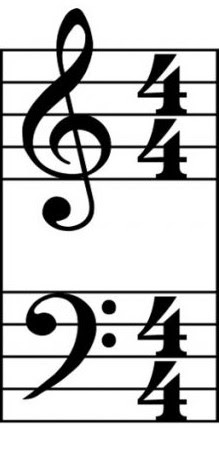
Most beginner musicians start with the simple meter of common time, or four beats per measure.
For some reason (fate? masochism?) I have chosen not just one but TWO organ voluntaries written in something one could call 'difficult times.'  Take a look at the time signature for the opening voluntary, a prelude based on hymn 631:
That means 10 beats per measure, with the 8th note getting the beat. Here is how the composer, Timothy Albrecth, organist emeritus of Emory Universoty, explains it:
SO I need to feel it in a group of 1, a group of 2, a group of three, then a group of four. This makes for a fun time, let me tell you!

But that is nothing in comparison with the closing voluntary, a piece called Serenade. Look at this time signature:
It starts out as 3+3+2+3, but later on he changes it to 13 beats to a measure. The composer wrote this for his own wedding in 1965 to be played by the organist as the guests left the ceremony. Not wishing to allow them the luxury of proceeding in an orderly 2/4, the composer wrote the work in 11/8, and in case anyone felt too comfortable, he changed it to 13/8 in the middle! The work has now been released in a number of different orchestrations of the original version for organ. This delightful miniature has entered the repertoire throughout the world.


Thursday, August 23, 2018

Music for August 26, 2018 + Rally Day

Vocal Music

  • Jubilate Deo – Dale Wood (1934-2003)

Instrumental Music

  • A Joyous Peal – Michael Bedford (b. 1949), Handbell Ensemble
  • Lord, enthroned in Heavenly Splendor – Larry Shackley (b. 1956)
  • Serenade for Organ - Derek Bourgeois (1941-2017)

Congregational Music (all hymns from the Hymnal 1982 with the exception of those marked “R” which are from Renew.)

  • Hymn 440 - Blessed Jesus, at thy word (LIEBSTER JESU)
  • Hymn 548 - Soldiers of Christ, arise (DIADEMATA)
  • Hymn 301 - Bread of the world, in mercy broken (RENDEZ A DIEU)
  • Hymn R195 - I come with joy to meet my Lord (LAND OF REST)
  • Hymn R218 - Broken for me (Janet Lunt)
  • Hymn 307 - Lord, enthroned in heavenly splendor (BRYN CALFARIA)
  • Psalm 34:15-22 – Tone VIIIa
We welcome the Good Shepherd Choir back to the loft this Sunday after their summer break. The choir celebrates Rally Day with the upbeat setting of a paraphrase of Psalm 100, Jubilate Deo, by the American composer Dale Wood. Wood was a highly respected composer of sacred music during the 20th century, with over 8 million copies of his music published in America and abroad. He was also an active organist-choirmaster, working in Lutheran and Episcopal churches in Hollywood, Riverside, and San Francisco, California.

Michael Bedford

A small ensemble from the Handbell Choir will be playing the opening voluntary. A Joyous Peal is by my friend Michael Bedford, Organist/Choirmaster Emeritus of St. John's Episcopal Church in Tulsa, where he served for over 25 years before retiring in 2015. He is now serving as national president of the American Guild of Organists. He has earned the BMus, BMusEd, and MMus degrees from Texas Christian University, and, in 1972-73, he studied organ with Michael Schneider at the Hochschule fur Musik in Cologne, Germany on a Fulbright scholarship. In 1998 he earned the DMA degree in organ performance from the University of North Texas.

A peal is a loud ringing of a bell or bells. Often it implies a repetitive pattern of bells. This piece builds on a repeated motif, adding layers and notes as it progresses.

The British Isles have provided us with some simple and often haunting folk melodies. Many of these tunes have been matched with hymn texts and become a treasured part of our hymnody. This is true with the tune SLANE which we sang last week to the words "Be thou my vision." On the other hand, composers such as the Welshman William Owens wrote original tunes which are so close to their "folk" roots that it's easy to assume they are traditional melodies. Such is the case of Owen's tune BRYN CALFARIA which we have been learning this month. Ralph Vaughan Williams, editor of The English Hymnal (1906) first paired this tune with the text "Lord, enthroned in heavenly splendor," a pairing that has perdured the test of time. Larry Shackley, a free-lance composer from Columbia, South Carolina, has written a lovely piano meditation on BRYN CALFARIA that I'll be playing at communion.
Larry Shackley

A native of Chicago, Shackley attended Eastman School of Music (M.M) and the University of South Carolina (D.M.A). He has had a varied career, from teaching at Columbia International University in Columbia, South Carolina, to working at the Moody Bible Institute in Chicago, creating original music and producing radio programs for the Moody Broadcasting Network, to composing for over 30 films, videotapes, and radio dramas. He has also served churches such as Willow Creek Community Church in South Barrington, Illinois as well as several churches in South Carolina. Shackley is also an active studio musician, arranger, and orchestrator. Recently, he has devoted most of his composing to music for the church, writing over 450 keyboard arrangements and 250 choral pieces for a variety of publishers.

The closing voluntary is a fun piece by the English composer Derek Bourgeois. Bourgeois was born in Dulwich, South London, England, studied music at Cambridge, and lectured in music at Bristol University for some years before becoming Director of the National Youth Orchestra. As a composer his energy was directed into major forms such as the symphony, oratorio and sonata, but he also has time for a joke in the true Haydn tradition and a sense of joie de vivre. His less 'serious' works include a 'Wine' Symphony, a Cantata Gastronomica, and this work for organ.

Derek Bougeouis
Bourgeois wrote this Serenade for his own wedding, to be played by the organist as the Bridal party left the ceremony. Not wishing to allow them the luxury of proceeding in an orderly 2/4, the composer wrote the work in 11/8, and in case anyone felt too comfortable, he changed it to 13/8 in the middle! "As the number of beats in a bar becomes increasingly odd, the listener is left wondering whether the music was designed to amuse the composer's musical bride as she walked up the aisle, or confuse his eminent Director of Studies who was in the congregation. Certainly he would have been able to unravel a hint or two of a famous Bolero from the music." [1]
This piece has become very popular with brass bands.

[1] Ian Carson, liner notes to "Organ Fireworks, Vol. 2, Christopher Herrick," Hyperion, CDA66258, CD © 1988