Showing posts with label Timothy Albrecht. Show all posts

Thursday, October 13, 2022

THESE ARE DIFFICULT TIMES - Music for Sunday, October 16, 2022 + Day School Sunday

Vocal Music

  • Jesus, Jesus – Sunday School Song
  • Shalom – Hebrew Melody

Instrumental Music

  • Prelude on “Liebster Jesu” – Timothy Albrecht (b. 1950)
  • Autumn – Antonio Vivaldi (1678-1741)
  • Serenade for Organ, Opus 22 – Derek Bourgeois (1941-2017)

Congregational Music (all hymns from The Hymnal 1982 with the exception of those marked “R” which are from Renew.)

Hymn 372 - Praise to the living God! (LEONI)
Hymn 631 - Book of books, our people’s strength (LIEBSTER JESU)
Hymn 535 - Ye servants of God, your Master proclaim (PADERBORN)
Hymn 711 - Seek ye first the kingdom of God (SEEK YE FIRST)
Hymn 530 - Spread, O spread, thou mighty word (GOTT SEI DANK)

This Sunday we will hear from the children of Good Shepherd School, lead by their music teacher Karen Silva. You will be amazed at what children ages 3-5 can do when it comes to vocal and instrumental music. We  are very fortunate to have the school here at our church, and they are lucky to have Karen teaching them about pitch, rhythm, and instruments.

Autumn from The Four Seasons    

One of the most amazing things they'll be doing is an instrumental number arranged from the first movement of Vivaldi's AUTUMN from "The Four Seasons." Intead of strings (like the original), the children will be using chimes and Boomwhackers®, color-coded, plastic, pitched, percussion tubes, designed to be 'whacked' against any surface, for a focused sound. Imagine playing music on empty rolls of wrapping paper. 

Prelude on Liebster Jesu and Serenade

There is a meme floating around musical circles that says
THESE ARE DIFFICULT TIMES

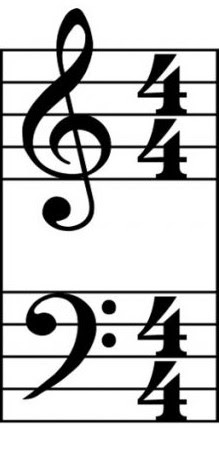
Most beginner musicians start with the simple meter of common time, or four beats per measure.
For some reason (fate? masochism?) I have chosen not just one but TWO organ voluntaries written in something one could call 'difficult times.'  Take a look at the time signature for the opening voluntary, a prelude based on hymn 631:
That means 10 beats per measure, with the 8th note getting the beat. Here is how the composer, Timothy Albrecth, organist emeritus of Emory Universoty, explains it:
SO I need to feel it in a group of 1, a group of 2, a group of three, then a group of four. This makes for a fun time, let me tell you!

But that is nothing in comparison with the closing voluntary, a piece called Serenade. Look at this time signature:
It starts out as 3+3+2+3, but later on he changes it to 13 beats to a measure. The composer wrote this for his own wedding in 1965 to be played by the organist as the guests left the ceremony. Not wishing to allow them the luxury of proceeding in an orderly 2/4, the composer wrote the work in 11/8, and in case anyone felt too comfortable, he changed it to 13/8 in the middle! The work has now been released in a number of different orchestrations of the original version for organ. This delightful miniature has entered the repertoire throughout the world.


Thursday, October 17, 2019

Music for October 20, 2019

Vocal Music

  • Let Us Go to the House of the Lord – Ellen McClune and Steve Taranto (The Coventry Choir)
  • Without the Fire - David Ashley White
  • Thou Knowest, Lord, the Secrets of our Heart - Henry Purcell 

Instrumental Music

  • Reflections on a Tune – David Ashley White
  • Book of Book, Our People’s Strength – Timothy Albrecht
  • Fanfare for Saint Anthony – David Ashley White

Congregational Music (all hymns from the Hymnal 1982 with the exception of those marked “R” which are from Renew.)

  • Hymn 372 - Praise to the living God! (LEONI)
  • Hymn 631 - Book of books, our people’s strength (LIEBSTER JESU)
  • Hymn 711 - Seek ye first the kingdom of God (SEEK YE FIRST)
  • Hymn R168 - If you believe and I believe (Zimbabwe)
  • Hymn R173 - O Lord, hear my prayer (Jacques  Berthier)
  • Hymn 530 - Spread, O spread, thou mighty word (GOTT SEI DANK)

This Sunday we hear the story of the Widow and the Apathetic Judge.  The widow comes to the judge day after day, petitioning him to decide on her behalf, and despite his indifference to the justice of her cause, he relents simply to get her off his back. In contrast to the judge’s apathy, God is empathetic: God cares and God wants us to receive blessings.

The idea of God as an empathetic judge is what sparked the choice of the two anthems the Good Shepherd Choir is singing. The communion anthem, Henry Purcell's "Thou Knowest, Lord" from the Funeral music for Queen Mary II in 1695, could very well have been sung by the persistent widow:
Thou knowest, Lord, the secrets of our hearts;
Shut not thy merciful ears unto our pray'rs;
But spare us, Lord most holy, O God most mighty.
O holy and most merciful Saviour,
Thou most worthy Judge eternal...
This anthem was sung at Purcell's very own funeral just eight months later in November, 1695.

 In the offertory anthem, we sing the phrase "Without the Judge, there is no Pleading," and we immediately thought of today's parable.

Rae Whitney, an English-born poet and hymn writer now living in Nebraska, has written a text, based on a few lines from Thomas รก Kempis, that reflects on what we would be missing if there were no faith or resurrection. It has been set to music by Houston composer David Ashley White, whose music is familiar to us here at Good Shepherd just as it is to musicians and choirs throughout the world. He is the Professor of Composition and Music Theory at the University of Houston.

This anthem is one of several that will be sung at the Diocese of Texas's annual Choral Festival next weekend at Christ Church Cathedral. It is a fine example of choral writing, with a beautiful melody, lush harmonies and changing meters of 4/2 to 3/2 that fit the rhythm of the words to create a powerful message. 

David writes more than just choral music, however. Organists are fortunate that he has written several lovely and interesting organ works. Two of those will be played today as the opening and closing voluntaries. The first, Reflections on a Tune, are his musings on his own hymn tune PALMER CHURCH, which is found at Hymn 327 in The Hymnal 1982. The name is in reference to White's home parish, Palmer Memorial Episcopal Church here in Houston.