Friday, November 23, 2018

Music for November 29, 2018 + Christ the King Sunday

Vocal Music
  • Christ the Glory - Jean - François Lallouette (1651-1728)
  • And Still the Bread is Broken – David Ashley White (b. 1944)
Instrumental Music
  • Praeludium in A – Johann Krieger (1651–1735)
  • The Peace May Be Exchanged – Dan Locklair (b. 1949)
  • Praeludium from Suite in D Minor – Johann Krieger
Congregational Music (all hymns from the Hymnal 1982 with the exception of those marked “R” which are from Renew.)
  • Hymn 494 - Crown him with many crowns (DIADEMATA)
  • Hymn 57 - Lo, he comes with clouds descending (HELMSLEY)
  • Hymn 450 - All hail the power of Jesus’ name (CORONATION)
  • Hymn R229 - Let all mortal flesh keep silence (PICARDY)
  • Hymn R227 - Jesus, remember me (Jacques Berthier)
  • Hymn 544 - Jesus shall reign (DUKE STREET)
  • Psalm 93 - Tone VIIIa
The last Sunday of the liturgical year is Christ the King Sunday, where we commemorate the Kingship of Christ. We'll sing many of your favorite hymns which refer to crowns and kingdoms.
The anthems, too, that Jesus is the King.

Lalouette
The offertory anthem refers to Jesus as the King of Glory. It is a work by a little known French composer of the Baroque period (ca. 1600–1750), Jean-François Lalouette. A very talented musician, he was a student of composition with the great opera composer Jean-Baptiste de Lully. Appointed as Lully’s assistant, Lully asked Lalouette to complete the internal parts of some of Lully’s opera, Isis. However, after Lalouette claimed credit for writing the better part of the opera, Lully fired him as his aide.

He must have been a difficult person with which to work, as he was fired from or denied opportunity to apply for several jobs during his lifetime. However difficult he must have been, he must have also been talented, as he won appointments at both the Cathedral in Rouen and Notre Dame in Paris, where he ended his career.

Born the same year as Lalouette, but in Germany, was the composer Johann Krieger. Krieger was renowned in his time, often put on par with J. S. Bach and Georg Frideric Handel. G.F. Handel himself confessed how much he owed to Krieger. Today, however, his fame fails in comparison to those great masters.

The Communion voluntary is a movement from Rubrics, a liturgical suite for organ in 5 movements by the North Carolina composer Dan Locklair. It was composed during the spring of 1988 in Winston Salem on a commission from the Organ Artist Series of Pittsburgh, Pennsylvania for their 10th anniversary year celebration, culminating in April 16, 1989 with the world premiere of Rubrics in Pittsburgh by the American organist, Mary Preston. The titles for each movement are from the instructions (rubrics) to the services for the book of common prayer. The Peace May Be Exchanged is from the Thanksgiving for the birth of a child, page 445. This lyrical Aria, featuring a solo diapason color parentheses accompanied by strings and double pedal throughout close parentheses, is based in D major.

Friday, November 16, 2018

Music for November 18, 2018

Vocal Music

  • Here, O My Lord – Eleanor Daley (b. 1955)

Instrumental Music

  • Prelude on “Old Hundredth” – Johann Pachelbel (1653-1706)
  • I Want to Walk as a Child of the Light – arr. Cathy Moklebust (b. 1958)
  • Toccata in C – Johann Pachelbel

Congregational Music (all hymns from the Hymnal 1982.)


  • Hymn 48 - O day of radiant gladness (ES FLOG EIN KLEINS WALDVOGELEIN)
  • Hymn 51 - We the Lord’s people, heart and voice uniting (DECATUR PLACE)
  • Hymn 301 - Bread of the world in mercy broken (RENDEZ À DIEU)
  • Hymn 685 - Rock of ages, cleft for me (TOPLADY)
  • Hymn 571 - All who love and serve your city (CHARLESTOWN)
  • Hymn 307 - Lord, enthroned in heavenly splendor (BRYN CALFARIA)
  • Psalm 16 – Tone VIIIa

Traditionally, women have never been leaders in the classical music scene. (Or any scene, for that matter.) I've come to realize (and often joke about) that the majority of the music we hear in church was written by dead white men. That's why I purposely looked for new music this summer that was written by women (dead or alive). Our budget for new music is woefully small, so I only bought a handful of new titles this summer, but the majority, I am proud to say, are by women. This Sunday features two works by women.

Eleanor Daley
The anthem this Sunday is a setting of the communion text, "Here, O My Lord," by the Canadian composer Eleanor Daley. Born and raised in Parry Sound, Ontario, Daley received her Bachelor of Music Degree in Organ Performance from Queen's University in Kingston, Ontario and holds diplomas in piano and organ from the Royal Conservatory of Music, Toronto and Trinity College, England. She has been the Director of Music at Fairlawn Avenue United Church (formerly Fairlawn Heights) in Toronto, Ontario since 1982. During this time, she has established a thriving choral program for which much of her music has been composed. You can read about this music program at their website, http://www.fairlawnchurch.ca/spirituality/music/
Cathy Moklebust


The Good Shepherd Handbell Guild is playing an arrangement of that favorite hymn "I Want to Walk as a Child of the Light," by the American Cathy Moklebust. Trained as a percussionist, she was first introduced to handbells when she was 12 years old at First Lutheran Church in Brookings, South Dakota. She has developed and directed handbell music programs since 1983. As one of today's most popular handbell music composers, she has approximately 250 published compositions and arrangements to her credit, many of them reaching bestseller status. Moklebust's music has been broadcast on "Today," "Good Morning, America," public television, public radio, and SiriusXM satellite radio.

I'm also playing a couple of organ works by the South German baroque composer, Johann Pachelbel. Yes, he's most famous today for his "Canon in D," but in his lifetime Pachelbel was known for his works for organ, and was considered one of the great organ masters of the generation before J.S. Bach. Pachelbel also taught organ, and one of his pupils was Johann Christoph Bach, who in turn gave his younger brother Johann Sebastian Bach his first formal keyboard lessons.

The opening voluntary is a chorale-prelude on the ubiquitous tune OLD HUNDREDTH, which we know as "the Doxology." The pedal carries the melody while the manuals (hands) provide the accompaniment.

The closing voluntary is a toccata which displays a lot of manual dexterity, but the pedal literally just sits on a low C. It's perfect for the lazy church organist. 

Thursday, November 8, 2018

Music for November 11, 2018 + Kirking of the Tartans

Vocal Music
  • Thou Art God – Lionel Bourne
Instrumental Music
  • Highland Cathedral - James D. Wetherald, arr., Richard Kean, piper
  • Lascia ch’io Pianga – G. F. Handel
Congregational Music (all hymns from the Hymnal 1982 with the exception of those marked “R” which are from Renew.)
  • Hymn 686 - Come, thou fount of every blessing (NETTLETON)
  • Hymn S-204 - Glory be to God on High - Old Scottish Chant
  • Hymn 429 - I’ll praise my maker while I’ve breath (OLD 113TH)
  • Hymn 707 - Take my life, and let it be (HOLLINGSIDE)
  • Hymn R172 - In my life, Lord, be glorified (LORD BE GLORIFIED)
  • Hymn R27 - O how he loves you and me (PATRICIA)
  • Hymn - In the Lord I’ll be ever thankful (Jacques Barthier)
  • Hymn 671 - Amazing grace! how sweet the sound (NEW BRITAIN)
  • Hymn 579 - Almighty Father, strong to save (MELITA)
  • Psalm 146 – Tone VIIIa
This is a favorite Sunday for many parishoners at Good Shepherd when we “Kirk (or bless) the Tartans.” This is a relatively new rite, beginning in the early 1940s, when Peter Marshall (the Presbyterian minister who was chaplain of the Senate - not the game show host) held prayer services at New York Avenue Presbyterian in D.C to raise funds for War Relief. At one of the services, he preached a sermon called “Kirking of the Tartans,” and thus a legend was born. You can read the entire fascinating history here on the Tartan Authority Website.
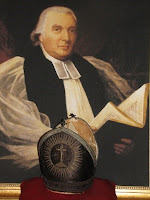
Samuel Seabury
We do it every year around Samuel Seabury day, the first American Anglican bishop who was consecrated by the Scottish Bishops of the Anglican church during the Revolutionary War. Ironically, Samuel Seabury was born on November 30, 1729, the day of St. Andrew, patron saint of Scotland, which may have presaged his future consecration as the first American Bishop when he was consecrated at St. Andrew’s Cathedral in Aberdeen, Scotland
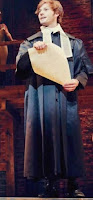
Seabury as
portrayed in the
musical "Hamilton"
Thus we commemorate his consecration by wearing our tartans, hanging them in the church, and hearing the bagpipes play. We begin the service with the piper playing “Highland Cathedral” and end with him playing “Amazing Grace.”

(Seabury appears in the musical "Hamilton" in the number "Farmer Refuted". He is an active Loyalist, someone who remains loyal to an established ruler especially during a revolt, preaching against the Revolution in front of important members of the American government and supporters of the Revolution. Hamilton then backs him down and eventually wins the debate after important members of the congress backed Hamilton. Seabury wrote his defense of the Loyalist position under the name A. W. Farmer, or A Westchester Farmer, hence "The farmer refuted.")

The anthem is a work by Lionel Bourne, Organist & Director of Music at the church of St John the Divine, Kennington (London). Bourne has been at St John’s since 2006.  A graduate of the Birmingham Conservatoire, he has many years’ experience as a church musician under his belt as well as a career in music at the BBC.

The text is by the Reverend Canon David Adam, former Vicar of the Holy Island of Lindisfarne. Lindisfarne is famous for its medieval religious heritage. In 635AD Saint Aidan came from Iona and chose to found his monastery on The Holy Island of Lindisfarne, thus making it a center of Celtic spiritualism. Mr. Adam’s poem sounds eversomuch like an ancient Gaelic Rune.

Bourne has scored this piece for four vocal parts (SATB) and organ. Marked "Flowing, but not too fast", the music is in G major and 3/4 time. The choir begins singing in unison, but by the second stanza begins to unfold into four parts. piece. Dynamically, the music begins softly and stays that way until the beginning of the third stanza, when a gradual crescendo climaxes on the text “Thou art the light, the truth, the way,” with pronounced breaks after “Light,” “truth,” and “way.” There is a diminuendo to a very soft ending as the choir repeats the final line “Thou art my Savior this very day.”

Lascia ch’io pianga (Let Me Weep) is an aria from the opera Rinaldo by George Frederick Handel. I'll admit it has nothing to do with church, per se, but it is very spiritual in nature. Mezzo-soprano Joyce DiDonato's includes it on her recent album with conductor Maxim Emelyanychev and the ensemble Il Pomo d'Oro, In War & Peace: Harmony Through Music. On this recording, she uses Baroque arias to explore the pain and possibilities of these troubled times. A companion website invites anyone and everyone to answer the simple but loaded question, "In the midst of chaos, how do you find peace?"

The piano arrangement I'm playing is from an old Etude magazine from 1919 - one year after World War I ended. It is arranged by Moritz Moszkowski, a German composer, pianist, and teacher of Polish-Jewish descent. He took quite a few liberties in his "transcription."


Wednesday, October 31, 2018

November 4, 2018 + All Saints Sunday

Vocal Music

  • By All Your Saints – Joel Martinson

Instrumental Music

  • Here I Am, Lord – Daniel Schutte
  • Concerto in A Minor (First Movement) – Antonio Vivaldi

Congregational Music (all hymns from the Hymnal 1982 with the exception of those marked “R” which are from Renew.)

  • Hymn 287 - For all the saints, who from their labor rest  (SINE NOMINE)
  • Hymn 286 - Who are these like stars appearing (ZEUCH MICH, ZEUCH MICH)
  • Hymn 822 - Through North and South and East and West (LAAST UNS ERFREUEN)
  • Hymn 620 - Jerusalem, my happy home (LAND OF REST)
  • Hymn 293 - I sing a song of the saints of God (GRAND ISLE)
  • Hymn 618  - Ye holy angels bright (DARWALL’S 148TH)
  • Psalm 24

All Saints Day is November 1. (Which is why we have All Hallow's Eve - Halloween - on October 31.) All Saints’ Day is when the church honors all Holy Ones, known and unknown. Our English word “saint” literally means “holy.” The next day, November 2, is All Soul's Day, the Commemoration of the Faithful Departed. In other cultures the celebration is known as Day of the Dead (Día de los Muertos in Spanish-speaking countries.)

Here at Good Shepherd we combine the two and observe them on the Sunday following. That's why we sing all the good old All Saints hymns (For All the Saints is regularly voted as one of the favorites of the congregation to sing) and read the list of names of those dear to us who have died. (This would be a good time for you to watch the animated movie Coco. (I think its the best of the Disney movies, able to be enjoyed by children and adults alike).

I am out of the country this week, so my good friend Rob Carty will be playing the organ for me in my absence. 

Friday, October 26, 2018

Music for October 28, 2018

Vocal Music

  • Alleluia from Exultate Jubilate, K.165  – W. A. Mozart (1756-1791) Christine Marku, soprano
  • Look at the World – John Rutter (b. 1945)

Instrumental Music

  • Declare the Maker's Praise - Joseph D. Daniel / arr. Tammy Waldrop
  • Arioso from Cantata 156 – Johann Sebastian Bach (1685-1750)
  • Sinfonia from Cantata 79: Wir Danken dir, Gott – J. S. Bach

Congregational Music (all hymns from the Hymnal 1982 with the exception of those marked “R” which are from Renew.)

  • Hymn 410 - Praise, my soul, the King of heaven (LAUDA ANIMA)
  • Hymn 302 - Father, we thank thee who hast planted (RENDEZ A DIEU)
  • Hymn 671 - Amazing grace! how sweet the sound (NEW BRITAIN)
  • Hymn 693 - Just as I am, without one plea (WOODWORTH)
  • Hymn 535 - Ye servants of God, your Master proclaim (PADERBORN)
  • Psalm 126 – Tone VIIIa
There's only one service this Sunday as we begin our 2018 Stewardship emphasis. Because of this, we pull out most of the stops for music this week!

We'll start out with an opening voluntary played by the Good Shepherd Handbell Guild. These 10 women meet each Wednesday morning during the school year. It's an interesting mix of ages, as the the youngest is 13 (we have three home-schooled youth). There are two sets of mother/daughters and one set of sisters. We have people with over 20 years of playing experience down to those playing for the first time.

The piece is an original composition by Joseph Daniel, a free-lance musician living in Michigan, with degrees in music from Baylor and the University of Michigan.

Then the Good Shepherd Choir will be joined by the Coventry Choir in John Rutter's beautiful anthem, Look at the World. Rutter is considered one of the leading living composers of sacred music. His anthem is perfect for our Stewardship emphasis as it enumerates the natural beauties that God created in the world and for which we give thanks.
Every good gift, all that we need and cherish,
Comes from the Lord in token of his love.
We are his hands, stewards of all his bounty,
His is the earth and his the heavens above.
Praise to thee, O Lord for all creation,
Give us thankful hearts that we may see
All the gifts we share, and every blessing,
All things come of thee
Mozart, age 18
Venanzio Rauzzini
engraved by Samuel Freeman 
Then at the offertory, Christine Irwin Marku will sing the soprano show-piece, Alleluia, from Mozart's Exsultate, jubilate.

Mozart was just 16 when he wrote this. The man (yes, man) for whom Mozart wrote it, Venanzio Rauzzini, was the Italian soprano castrato of choice for the musical chattering classes of Milan. The composer and performer had been flung together to produce Mozart’s early opera, Lucio Silla, in which Rauzzini starred. The singer would eventually, after a couple more adulatory years wowing them in Italy, move permanently to the unlikely destination of Bath, England, living largely off his reputation by teaching and mounting subscription concerts.

Thursday, October 18, 2018

Music for October 21, 2018 + Good Shepherd School Sunday

Vocal Music


  • I Know I’m a Child of God - Lonnie Stanford

Instrumental Music

  • Dona nobis Pacem - Traditional, arr. Tom Anderson
  • Rhosymedre – Ralph Vaughan Williams 
  • Symphony No. 9 “Ode to Joy” - Beethoven, arr. Tom Anderson      

Congregational Music (all hymns from the Hymnal 1982 with the exception of those marked “R” which are from Renew.)

  • Hymn 8 - Morning is broken (BUNESSAN)
  • Hymn 405 - All things bright and beautiful (ROYAL OAK)
  • Hymn 380 - From all that dwell below the skies (OLD HUNDREDTH)
  • Hymn R289 - Jesu, Jesu (CHEREPONI)
  • Hymn R148 - Brother, let me be your servant (SERVANT SONG)
  • Song - The Lord is my shepherd
  • Hymn 530 - Spread, O spread, thou mighty word (GOTT SEI DANK)
  • Psalm 91:9-6 Tone
Today is Good Shepherd School Sunday at the 10:15 service in the nave. The children of our day school will sing the offertory anthem today, and their Bell/Boomwhacker ensemble will play the opening and closing voluntaries. Karen Silva is the music teacher at our school and does a fabulous job teaching them rudiments of music in addition to learning to sing.

Founded in 1984, Good Shepherd School began with 2 classes and 22 children. Today, we have over 15 classes and maintain a regular student roster of over 300 students. We have school-year programs for children ages 1 through Kindergarten.

Friday, October 12, 2018

Music for October 14, 2018

Vocal Music

  • Prayer – Mark Schweitzer (b. 1956)

Instrumental Music

  • Partita on “St. Anne” – Paul Manz (1919-2009)
    • I. Theme
    • II. Adagio
    • V. Pastorale
    • VI. Fugue-finale

Congregational Music (all hymns from the Hymnal 1982 with the exception of those marked “R” which are from Renew.)

  • Hymn 680 - O God, our help in ages past (ST. ANNE)
  • Hymn 488 - Be thou my vision (SLANE)
  • Hymn 707 - Take my life, and let it be (HOLLINGSIDE)
  • Hymn R145 Lord, I want to be a Christian (I WANT TO BE A CHRISTIAN)
  • Hymn R152 I want to walk as a child of the light (HOUSTON)
  • Hymn 408 Sing praise to God who reigns above (MIT FREUDEN ZART)
  • Psalm 90:12-17 – Tone VIIIa
North Carolina composer Mark Schweitzer has written a lovely, gentle setting of the hymn "King of Glory, King of Peace" which is deceptively simple sounding. It's easy to listen to because of the lyrical melody which beautifully aligns with the lyrics, as well as the luscious harmonies that support the melody, but it is much harder to sing than it would appear because of those harmonies. You have different parts singing suspensions, appoggiaturas, and other challenging harmonic devices. You have an accompaniment that, which supporting the singers, is still very independent.

George Herbert
The hymn King of glory, King of peace is by the British poet and priest George Herbert. Born to a wealthy Welsh family in 1593, he attended Trinity College, Cambridge in and graduated with a Bachelor's and a master's degree in 1616 at the age of 23. It looked like he was headed to a career in public service with his appointment to Parliament in 1624, but God had other plans, and he entered the priesthood in 1629. He was appointed as rector of the small rural parish of St. Andrew's in  Bemerton,  Wiltshire, near Salisbury. Here he preached and wrote poetry in Latin, Greek, and English.

His time at Bemerton was short-lived, however.  Having suffered for most of his life from poor health, in 1633 Herbert died of consumption only three years after taking holy orders. Shortly before his death, he sent a collection of his English poems, called The Temple to a friend, reportedly telling him to publish the poems if he thought they might "turn to the advantage of any dejected poor soul", otherwise to burn them. Thankfully, they were published not long after his death.

King of Glory, King of Peace can be found as a hymn in our hymnal, at no. 382, sung to another tune. In fact, we have two other settings of this text in our choir library, composed by Harold Friedell and Gerald Near.

The opening hymn for Sunday is the grand old hymn, O God, our help in ages past, by Issac Watts. Since the Psalm for this Sunday is the last half of Psalm 90, I decided to sing this hymn, which is considered to be one of the best paraphrases of the first six verses of Psalm 90 by Watts.  All of the organ music will be from Paul Manz's set of variations on the hymn tune forever associated with that text, St. Anne. These variations were probably improvised by Manz during a recital or one of his Hymn Festivals, and later published as Partita on St. Anne.